
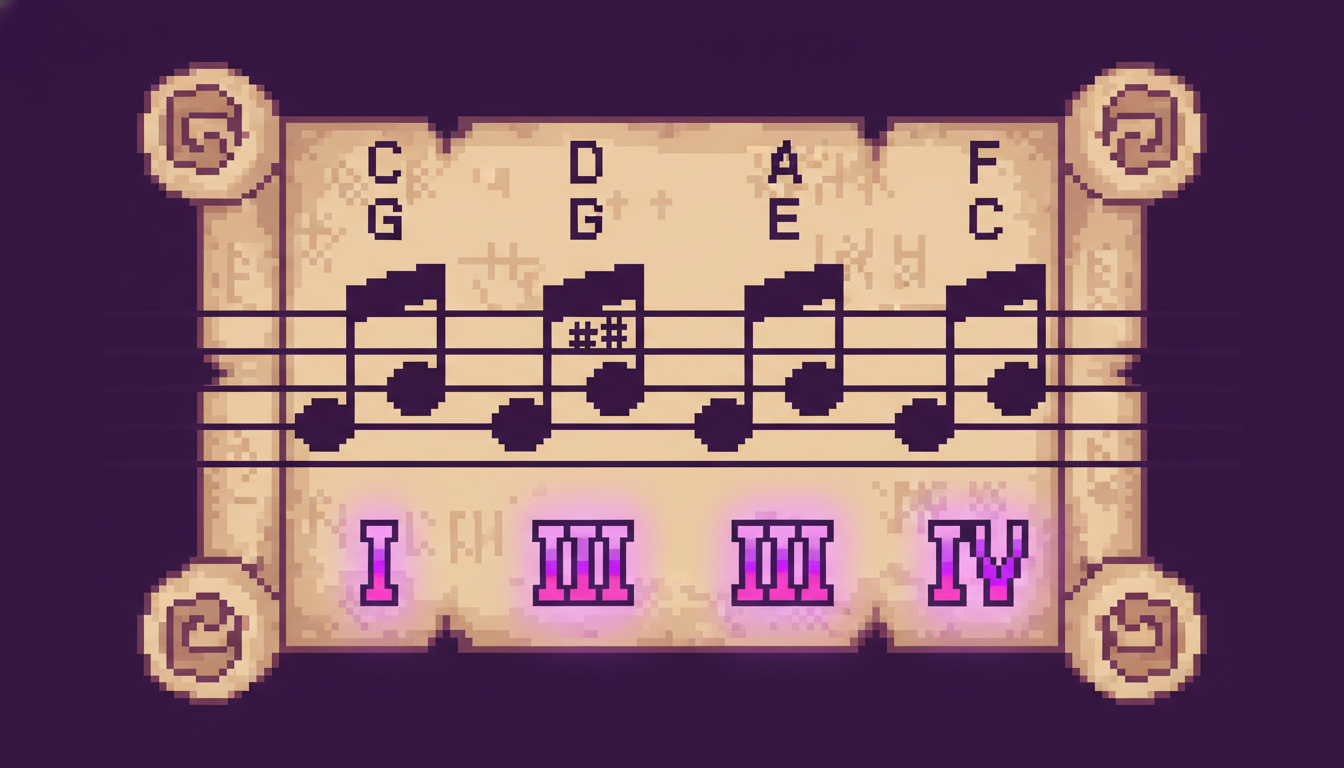
Once you know how chords are built and which chords belong to a key, the next leap in fluency is realizing that the same handful of chord functions show up in nearly every song you have ever heard. Roman numeral analysis is the system musicians use to talk about those functions in a way that is completely independent of key. Learn it well, and a I-V-vi-IV progression in C major and the same progression in F# major become the same idea, not two separate things to memorize.
Why does Roman numeral analysis exist?
Naming chords by letter (“C, G, Am, F”) tells you which chords to play but nothing about why they work or how they function. Move the song to a different key and every name changes. Roman numerals label each chord by its scale-degree position instead, so the function stays the same across keys — which is exactly what you want to remember.
If you describe a song’s chord progression as “C, G, Am, F,” you have communicated something useful but limited. You have told someone which chords to play, but not why those chords work or what role each one is playing. Move that progression to a different key and the chord names change entirely. Now you have to relearn the song’s structure for every key.
Roman numerals solve this. Instead of naming chords by their root note, you label each chord by its position in the key. The chord built on the first scale degree is the I (one) chord. The chord built on the fifth scale degree is the V (five) chord. The labels stay constant across keys, so the function of the chord is what you remember.
What are the seven diatonic Roman numerals in a major key?
In any major key the diatonic chords follow this fixed pattern: I (major), ii (minor), iii (minor), IV (major), V (major), vi (minor), vii° (diminished). Uppercase = major, lowercase = minor, ° = diminished. In C major: C, Dm, Em, F, G, Am, B°. The pattern never changes between major keys.
| Scale degree | Quality | Numeral |
|---|---|---|
| 1 | Major | I |
| 2 | Minor | ii |
| 3 | Minor | iii |
| 4 | Major | IV |
| 5 | Major | V |
| 6 | Minor | vi |
| 7 | Diminished | vii° |
In C major, those become C, Dm, Em, F, G, Am, and B°. In G major: G, Am, Bm, C, D, Em, and F#°. In Eb major: Eb, Fm, Gm, Ab, Bb, Cm, and D°. The pattern of upper- and lowercase, the I-ii-iii-IV-V-vi-vii° template, never changes between major keys.
That stability is the entire point. Once you know the seven chords of any major key, you know the seven chords of every major key.
What are the seven Roman numerals in a minor key?
In natural minor: i (minor), ii° (diminished), III (major), iv (minor), v (minor), VI (major), VII (major). In A minor: Am, B°, C, Dm, Em, F, G. Composers usually raise the 7th to create a major V chord (E major in A minor) for stronger cadences, borrowing from harmonic minor.
| Scale degree | Quality | Numeral |
|---|---|---|
| 1 | Minor | i |
| 2 | Diminished | ii° |
| 3 | Major | III |
| 4 | Minor | iv |
| 5 | Minor | v |
| 6 | Major | VI |
| 7 | Major | VII |
In A minor: Am, B°, C, Dm, Em, F, G. In E minor: Em, F#°, G, Am, Bm, C, D.
Composers often raise the seventh degree to create a major V chord (an E major chord in A minor instead of E minor), borrowing from harmonic minor. When that happens, you write V instead of v, signaling the altered quality. This is so common in tonal music that the major V in a minor key is the default expectation, not the exception.
What are primary and secondary chord functions?
Primary chords are I (tonic, home), IV (subdominant, departure), and V (dominant, the strongest pull back to I). They carry most of the harmonic weight in tonal music. Secondary chords are ii (a softer subdominant), iii (rare, substitutes for I or vi), vi (relative minor, gentler tonic), and vii° (unstable, behaves like a stripped-down V).
Of the seven diatonic chords, three carry most of the harmonic weight in tonal music. These are the primary chords:
- I (tonic) — the home chord. Stable, resolved, the destination.
- IV (subdominant) — pulls away from home, a step toward tension.
- V (dominant) — the strongest pull back to I, the engine of resolution.
Almost every traditional song spends most of its time alternating between these three. Twist and Shout, La Bamba, and countless blues tunes are nearly pure I-IV-V.
The other four chords (ii, iii, vi, vii°) are secondary chords. They expand the harmonic palette:
- ii is a softer subdominant, often used to set up the V (the famous ii-V-I)
- iii is rare; it can substitute for I or vi
- vi is the relative minor — it sounds like a gentler tonic
- vii° is unstable and almost always resolves to I, behaving like a stripped-down V
Recognizing primary versus secondary functions is what lets you predict where a song is going on a single hearing.
What are the most common Roman numeral progressions?
I-V-vi-IV is the modern pop standard (Let It Be, Don’t Stop Believing). I-IV-V is the blues and rock skeleton. ii-V-I is the cornerstone of jazz. I-vi-IV-V is the 1950s doo-wop progression (Stand By Me, Earth Angel). vi-IV-I-V is a melancholy-to-uplift variant of the I-V-vi-IV chords.
I - V - vi - IV. The defining progression of modern pop. Let It Be, Don’t Stop Believing, No Woman No Cry, hundreds more.
I - IV - V. The skeleton of blues, rock and roll, and country. Add a 7th to the V and you have the entire 12-bar blues form.
vi - IV - I - V. Same chords as the first progression, started in a different place. Sounds melancholic, then lifts.
ii - V - I. The cornerstone of jazz. Almost every jazz standard cycles through this pattern, often modulating through different keys.
I - vi - IV - V. The 1950s doo-wop progression. Stand By Me, Earth Angel, Heart and Soul.
If you write these out in any major key by replacing the numerals with the corresponding chords, you can play them immediately. That is transposition without thinking.
How do you notate chord inversions with Roman numerals?
Use figured bass symbols inherited from classical music. No symbol means root position. A 6 means first inversion (third in the bass). 6/4 means second inversion (fifth in the bass). So I⁶ in C major means a C-major chord with E in the bass. Modern lead sheets often use slash notation (C/E) for the same idea.
- No symbol = root position (root in the bass)
- 6 = first inversion (third in the bass)
- 6/4 = second inversion (fifth in the bass)
So I⁶ in C major means a C-major chord with E in the bass. V⁶/₄ in C major means a G-major chord with D in the bass. In modern lead sheets, this is more commonly written with slash notation: C/E or G/D. They mean the same thing.
How does Roman numeral analysis extend beyond the diatonic chords?
Borrowed chords from a parallel key get notation like bVII (B-flat major in C major, borrowed from C minor). Secondary dominants — chords that act as V of something other than I — are written V/V (“five of five”) or V/vi. These extensions let analysts describe the rich harmony of jazz, classical, and film music using the same compact vocabulary.
Once you are comfortable with diatonic Roman numerals, the system extends beautifully into more advanced territory. Borrowed chords (chords from a parallel key) get notation like bVII or iv. Secondary dominants (chords that act as a V of something other than I) are written as V/V (“five of five”) or V/vi. These let analysts describe the rich harmony of jazz, classical, and film music with the same compact vocabulary.
How do you build fluency with Roman numerals?
Always think in numerals when learning a song — translate chord names to numerals before committing anything to memory. Practice transposing songs you know into three other keys. When you hear a chord change, name its function (home, departure, tension, sadness) before naming its letter. The function/feel mapping wires in fast.
Always think in numerals when you learn a song. When someone hands you a chord chart, mentally translate to Roman numerals before you commit anything to memory. The numeric pattern will stick far longer than the chord names.
Practice transposing. Take a song you know in one key and rewrite the progression in three other keys. The mechanical exercise wires the numeral-to-chord conversion into your fingers and ear.
Listen for function, not just sound. When you hear a chord change, ask whether it feels like home (I), departure (IV or ii), tension (V), or sadness (vi). The function names start to map to feelings quickly.
Roman numeral analysis is one of those skills that pays dividends for the rest of your musical life — it touches songwriting, improvisation, ear training, and transposition all at once. Music Genius’s Theory Quest introduces Roman numerals in Tier 4 alongside diatonic triad construction, with interactive drills that reinforce the labels in every major key. Pair this with Nashville Number System for the popular-music counterpart and Diatonic Chords Explained for the underlying theory.
Frequently Asked Questions
What is Roman numeral analysis in music?
Roman numeral analysis labels each chord in a key by its scale-degree position using Roman numerals. The chord on the 1st scale degree is I, the 5th is V, and so on. Uppercase numerals indicate major chords, lowercase indicate minor, and a small circle marks diminished — making chord function visible regardless of key.
What are the seven diatonic Roman numerals in a major key?
In any major key the diatonic chords are I (major), ii (minor), iii (minor), IV (major), V (major), vi (minor), and vii° (diminished). In C major these are C, Dm, Em, F, G, Am, and B°. The pattern of uppercase, lowercase, and the diminished symbol is identical across all 12 major keys.
What are the seven Roman numerals in a minor key?
In natural minor the chords are i (minor), ii° (diminished), III (major), iv (minor), v (minor), VI (major), and VII (major). In A minor: Am, B°, C, Dm, Em, F, G. Composers usually raise the 7th to create a major V chord (E major in A minor), borrowing from harmonic minor for stronger cadences.
What is the difference between Roman numerals and Nashville numbers?
Both label chords by scale degree. Roman numeral analysis uses uppercase/lowercase Roman numerals (I, V, ii, vi) to encode chord quality explicitly and is the academic standard. The Nashville Number System uses Arabic numerals (1, 5, 2, 6), assumes quality from context, and is faster to write — preferred by session musicians and worship bands.
What are primary and secondary chords?
Primary chords are I, IV, and V — the most important chords in a key, carrying most of the harmonic weight in tonal music. Secondary chords are ii, iii, vi, and vii°, which expand the palette. The ii sets up the V (the famous ii-V-I), vi is the relative minor, and vii° behaves like a stripped-down V.
What is the most common chord progression?
The I-V-vi-IV progression is the defining pattern of modern pop — used in Let It Be, Don't Stop Believing, No Woman No Cry, and hundreds of others. I-IV-V is the skeleton of blues and rock. ii-V-I is the cornerstone of jazz. I-vi-IV-V is the doo-wop progression of the 1950s.
How do you indicate chord inversions in Roman numeral analysis?
Use figured bass symbols. No symbol = root position. The number 6 = first inversion (third in bass). The numbers 6/4 = second inversion (fifth in bass). So I⁶ in C means a C-major chord with E in the bass. In modern lead sheets this is more commonly written with slash notation (C/E), which means the same thing.
PRACTICE WHAT YOU LEARNED
Put this knowledge to work with Music Genius — free music theory games that make practice fun.
Play Now — It's Free