
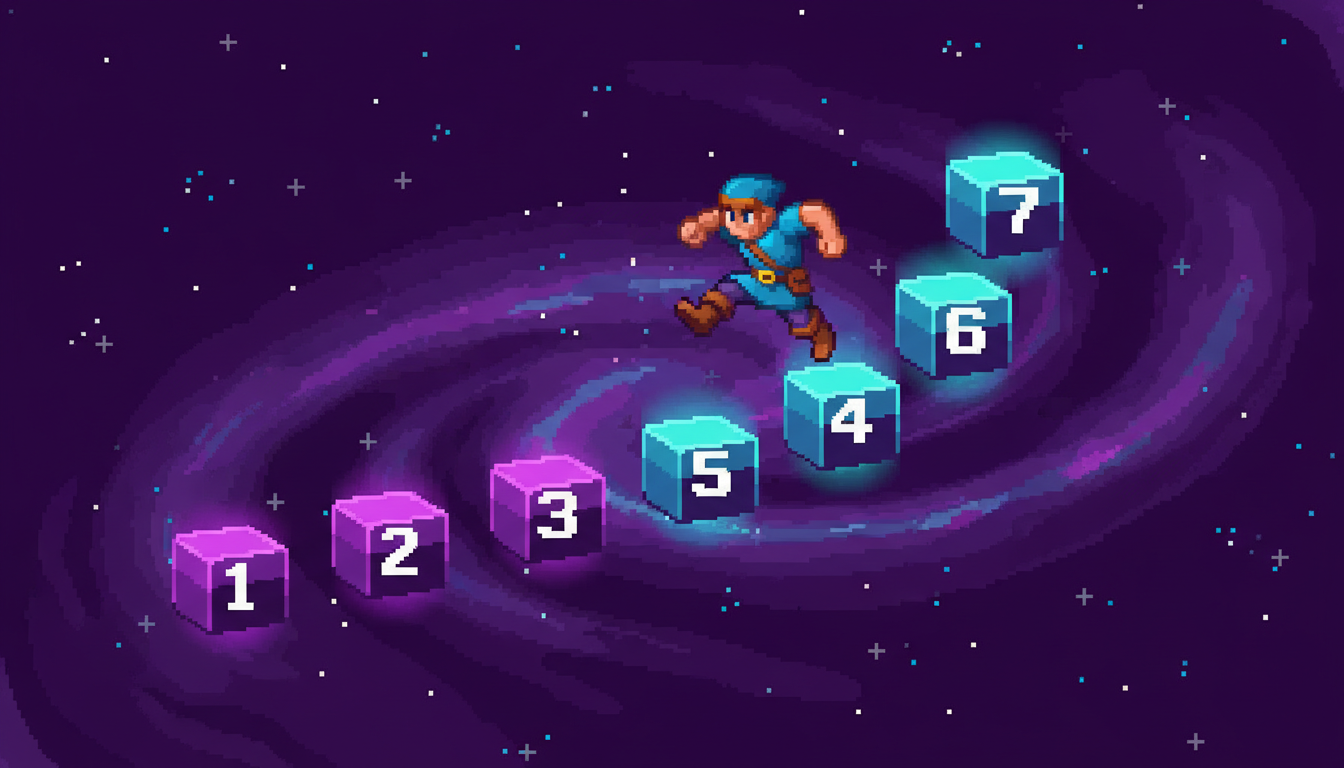
Most musicians who struggle with improvisation share the same problem: they think in note names. They memorize that a C major scale has C, D, E, F, G, A, and B, then try to string those notes together into something musical. The result is usually aimless noodling, running up and down the scale without any sense of direction or purpose.
The fix is surprisingly simple. Stop thinking about which notes to play and start thinking about which scale degrees to play. This single shift in perspective transforms improvisation from a guessing game into a conversation with the harmony.
What is a scale degree?
Scale degrees are numbers assigned to each note of a scale based on its position. In any major scale: 1 (tonic), 2 (supertonic), 3 (mediant), 4 (subdominant), 5 (dominant), 6 (submediant), 7 (leading tone). The numbers stay constant — only the note names change between keys. They describe musical function, not pitch.
- 1 = root (tonic)
- 2 = second (supertonic)
- 3 = third (mediant)
- 4 = fourth (subdominant)
- 5 = fifth (dominant)
- 6 = sixth (submediant)
- 7 = seventh (leading tone)
In C major, 1 is C, 3 is E, 5 is G. In Bb major, 1 is Bb, 3 is D, 5 is F. The numbers stay the same; only the note names change. This is the key insight: scale degrees describe function, not pitch. The number 3 always has the same emotional quality relative to its key, regardless of what note it happens to be.
Why do numbers beat note names for improvisation?
Note names change in every key — F# major demands a completely different mental model than C major. Scale degrees use the same framework everywhere. The 1 always feels like home. The 7 always creates tension that wants to resolve up to 1. This is how jazz musicians can sit in on a tune they have never heard, get told “it’s a ii-V-I in Eb,” and immediately play convincing solos.
When you think in scale degrees, every key uses the same framework. The 1 always feels like home. The 7 always creates tension that wants to resolve up to 1. The b3 always sounds bluesy. You build a vocabulary of sounds and feelings that transfers instantly to any key, any song, any chord progression.
This is how experienced jazz musicians can sit in on a tune they have never heard, get told “it’s a ii-V-I in Eb,” and immediately play convincing solos. They are not calculating note names. They are hearing and thinking in degrees.
How do you target chord tones in a solo?
Land on chord tones (1, 3, 5, 7 of each chord) on strong beats — beats 1 and 3 in 4/4. Over Cmaj7, target C, E, G, B. When the chord changes to Dm7, target D, F, A, C. Everything between chord tones is a path through scale tones. Your solo will sound connected to the harmony because it is literally built on it.
Chord tones are the 1, 3, 5, and 7 of each chord in the progression. When the harmony is a Cmaj7, the chord tones are C (1), E (3), G (5), and B (7). When it moves to Dm7, the chord tones shift to D (1), F (3), A (5), and C (7).
A Practical Exercise
Take a simple I-vi-IV-V progression in C major: Cmaj7 - Am7 - Fmaj7 - G7.
- First, play only the root of each chord on beat 1. Just one note per bar. Listen to how even this bare-bones melody outlines the harmony.
- Next, play the third of each chord on beat 1: E over Cmaj7, C over Am7, A over Fmaj7, B over G7. Notice how these notes create a different melody that still perfectly tracks the harmony.
- Now alternate: play the root on beat 1 and the third on beat 3. You are improvising with just two notes per bar, and it already sounds intentional.
- Finally, fill in the spaces between chord tones with scale tones. The chord tones are your destinations; the scale tones are your paths.
This approach guarantees that your solos always sound connected to the harmony, because they are literally built on it.
Which scale degrees are stable and which create tension?
Stable degrees: 1 (root, maximum stability), 3 (defines major/minor quality), 5 (strong and open). Tension degrees: 7 (strong pull up to 1), 4 (suspends, wants to drop to 3), 2 (mild — resolves up or down), 6 (gentle — often resolves to 5). Knowing this hierarchy is what separates expressive solos from mechanical scale runs.
Stable Degrees (Resolution Points)
- 1 (root): Maximum stability. Landing here feels like arriving home.
- 3 (third): Stable and warm. Defines the major or minor quality of the key.
- 5 (fifth): Strong and open. Stable but less final than the root.
Tension Degrees (Movement Points)
- 7 (major seventh): Strong pull upward to 1. Creates longing and anticipation.
- 4 (fourth): Pulls downward to 3. The classic suspension sound.
- 2 (second): Mild tension. Can resolve down to 1 or up to 3.
- 6 (sixth): Gentle tension. Often resolves to 5.
The Blue Notes
In blues-influenced styles, three chromatic alterations add a whole layer of expressive color:
- b3 (flat third): The quintessential blues sound. Played over a major chord, it creates a sweet-sour tension.
- b5 (flat fifth): The “blue note.” Gritty and unstable, it slides between 4 and 5.
- b7 (flat seventh): The dominant seventh sound. Adds edge and forward motion.
When you know that the b7 always creates a bluesy, unresolved feeling, you can deploy it at will in any key without having to think about whether it is Bb (in C) or Ab (in Bb) or F (in G).
How do you build real melodic phrases instead of running scales?
Three techniques: call-and-response (a phrase ending on tension followed by a phrase that resolves it), enclosure (approach a target chord tone from a half step above and below), and rhythmic variation (a simple 3-note motif with rhythmic variety beats complex notes with repetitive rhythm).
The Call-and-Response Pattern
Play a short phrase (the “call”), then play a complementary phrase (the “response”). The call might end on a tension degree, and the response resolves it.
Example over a C major vamp:
- Call: Start on 5 (G), move up to 6 (A), land on 7 (B). The phrase hangs in the air, unresolved.
- Response: Start on 1 (C, the octave above), step down through 7 (B) to 6 (A), and land on 5 (G). Resolution and completion.
The Enclosure Technique
Approach a target chord tone from one half step above and one half step below. To land on the 3 (E) over a C chord, play F then D# (or Eb) before arriving on E. This chromatic enclosure works in every key because you are thinking about the target degree, not specific chromatic notes.
Rhythmic Variation
Scale degrees free up mental space to focus on rhythm, which is often more important than note choice. Try this: take a simple three-note motif (say, 1-2-3) and play it with different rhythms. Swing it. Syncopate it. Leave space. Repeat it. You will find that rhythmic variety over simple note choices sounds far more musical than complex note choices with repetitive rhythm.
What is a four-week routine for developing scale-degree thinking?
Week 1: sing the numbers (play root, sing “one, two, three…” in several keys). Week 2: chord tone soloing (only 1, 3, 5, 7 over backing tracks — no passing tones). Week 3: add stepwise approach notes. Week 4: deliberate tension and release — hold a tension note for a full beat before resolving.
Week 1: Sing the Numbers
Pick a key and play the root on your instrument. Then sing the major scale using numbers: “one, two, three, four, five, six, seven, one.” Do this in several keys. The goal is to internalize the sound of each degree relative to the tonic.
Week 2: Chord Tone Soloing
Over a backing track or metronome, improvise using only chord tones (1, 3, 5, 7 of each chord). No passing tones. Force yourself to hear and target the harmony.
Week 3: Add Approach Notes
Now connect chord tones with stepwise motion and occasional chromatic approach notes. Keep your chord-tone targets on strong beats.
Week 4: Tension and Release
Deliberately use tension degrees (4, 7, 2, 6) and resolve them. Practice holding a tension note for a full beat before resolving it. Get comfortable with the sound of suspended resolution.
What are the most common improvisation mistakes?
Running scales up and down (scales are raw material, not melodies). Ignoring chord changes (your line floats above harmony instead of locking in). Never resting (space is one of improv’s most powerful tools — Miles Davis is famous for what he didn’t play). Staying in one register (use the full range for emotional arc).
Running the scale up and down. Scales are raw material, not melodies. No one speaks by reciting the alphabet.
Ignoring the chord changes. If you play the same pattern regardless of what chord is sounding, your solo will float above the harmony instead of locking into it.
Never resting. Space is one of the most powerful tools in improvisation. A well-placed rest creates anticipation and gives the listener time to absorb what you just played. Think of Miles Davis: what he did not play was as important as what he did.
Staying in one register. Use the full range of your instrument. A phrase that climbs from a low 5 up to a high 3 has a completely different emotional arc than one that stays in a narrow band.
Music Genius lets you practice thinking in scale degrees with interactive exercises across multiple keys and difficulty levels — try Build the Scale and Pitch ID to drill the foundation. Pair this with How to Practice Scales and Pentatonic Scale Guide for a complete improvisation toolkit.
Frequently Asked Questions
What is a scale degree?
Scale degrees are numbers assigned to each note of a scale based on its position. In any major scale: 1 (tonic), 2 (supertonic), 3 (mediant), 4 (subdominant), 5 (dominant), 6 (submediant), 7 (leading tone). The numbers stay constant across keys — only the note names change. They describe function, not pitch.
Why should improvisers think in scale degrees instead of note names?
Note names change in every key — F# major demands a completely different mental model than C major. Scale degrees use the same framework everywhere. The 1 always feels like home; the 7 always pulls to 1. This is how jazz musicians sit in on tunes they have never heard, get told 'it's a ii-V-I in Eb,' and play convincingly.
How do you target chord tones in a solo?
Land on chord tones (1, 3, 5, 7 of each chord) on strong beats — beats 1 and 3 in 4/4. Everything between is a path connecting those landing points. Over Cmaj7, target C, E, G, B. When the chord changes to Dm7, target D, F, A, C. Your line will sound connected to the harmony because it's literally built on it.
Which scale degrees are stable vs tense?
Stable: 1 (root, maximum stability), 3 (defines major/minor quality), 5 (strong and open). Tension: 7 (strong pull up to 1), 4 (suspends, wants to drop to 3), 2 (mild — resolves up or down), 6 (gentle — often resolves to 5). Knowing the hierarchy is what separates expressive solos from mechanical scale runs.
What are blue notes?
Blue notes are three chromatic alterations that add expressive color to a major-scale framework: b3 (flat third — bluesy tension over a major chord), b5 (the 'blue note' — gritty, slides between 4 and 5), and b7 (flat seventh — dominant edge and forward motion). Each works in any key because you think in degree, not specific note.
How do you build melodic phrases instead of running scales?
Use call-and-response: a short phrase ending on tension (call) followed by a complementary phrase that resolves it (response). Use enclosure: approach a target chord tone from a half step above and below before landing. Vary rhythm — a simple three-note motif with rhythmic variety beats complex notes with repetitive rhythm.
What are the most common improvisation mistakes?
Running scales up and down (scales are raw material, not melodies — no one speaks by reciting the alphabet). Ignoring chord changes (your line floats above instead of locking in). Never resting (space is one of the most powerful tools — Miles Davis is as famous for what he didn't play). Staying in one register (use the full range).
PRACTICE WHAT YOU LEARNED
Put this knowledge to work with Music Genius — free music theory games that make practice fun.
Play Now — It's Free