
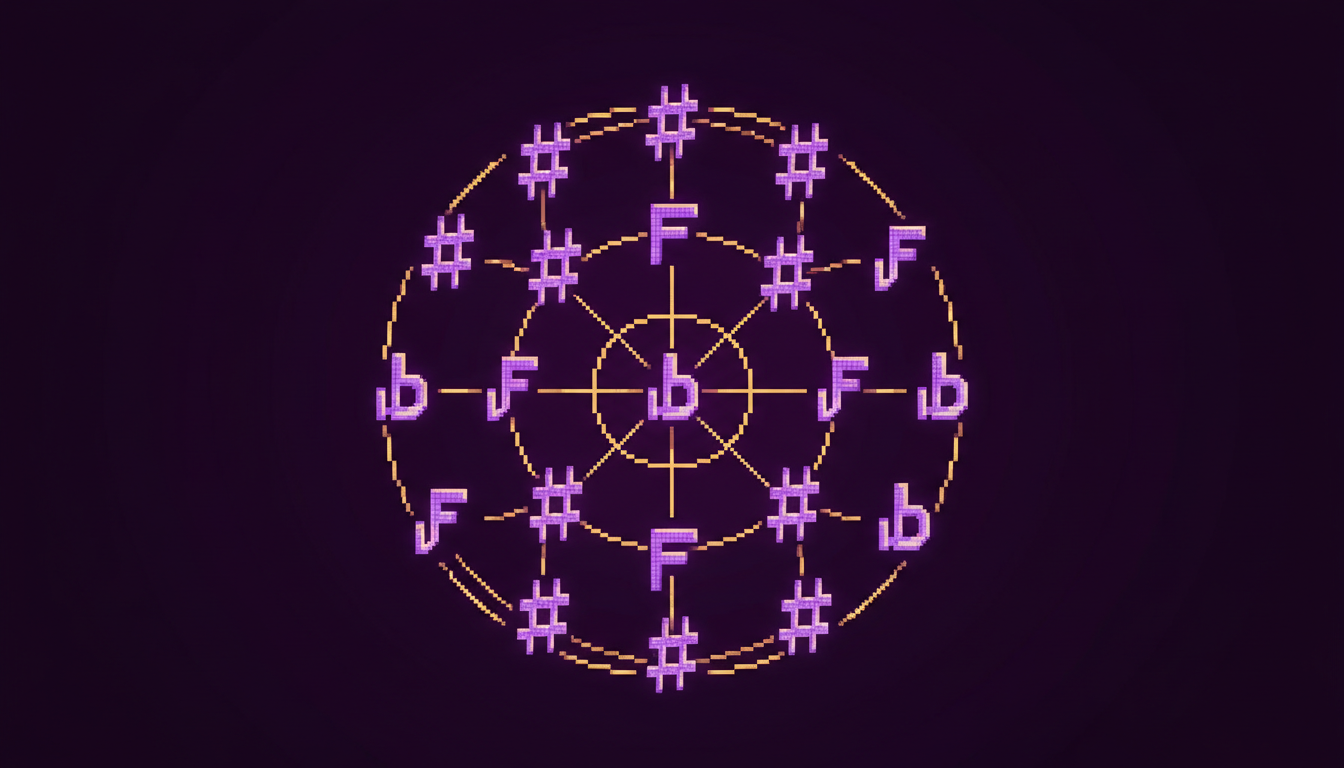
Key signatures are one of those fundamentals that every musician needs to know cold. Whether you are sight-reading a new piece, transposing on the fly, or writing your own music, instant recall of key signatures saves time and mental energy. The good news is that key signatures follow elegant patterns, and once you see those patterns, memorization becomes surprisingly straightforward.
What is a key signature and why does it matter?
A key signature is a group of sharps or flats placed at the start of each staff that tells you which notes are altered throughout the piece. Instead of marking every F# in G major individually, one sharp on the F line handles all of them. It also instantly identifies the tonal center of the music.
A key signature tells you which notes are sharp or flat throughout a piece of music. Instead of writing an accidental next to every F-sharp in the key of G major, the composer places a single sharp on the F line at the beginning of each staff. This keeps the notation clean and immediately communicates the tonal center of the music.
Knowing key signatures also unlocks deeper understanding. When you see three flats, you should instantly think “E-flat major or C minor” and already know the scale, the diatonic chords, and the likely harmonic vocabulary of the piece.
What is the order of sharps and flats?
Sharps always appear in the order F-C-G-D-A-E-B (mnemonic: Father Charles Goes Down And Ends Battle). Flats appear in the reverse order: B-E-A-D-G-C-F (Battle Ends And Down Goes Charles’s Father). These orders never change, so a three-sharp signature is always F#, C#, G#.
Before diving into mnemonics, you need to know that sharps and flats always appear in a fixed order.
Sharps: F - C - G - D - A - E - B
The classic mnemonic is Father Charles Goes Down And Ends Battle. Each word’s first letter corresponds to a sharp in order. When a key has two sharps, they are always F-sharp and C-sharp. Three sharps? F-sharp, C-sharp, and G-sharp. The order never changes.
Flats: B - E - A - D - G - C - F
Notice this is the sharp order reversed. The mnemonic runs backward: Battle Ends And Down Goes Charles’s Father. One flat is always B-flat. Two flats are B-flat and E-flat. Simple and consistent.
How do you identify a major key from a sharp key signature?
Look at the last sharp in the signature and go up one half step. That note names the key. If the last sharp is F#, the key is G major. If it is D#, the key is E major. The only sharp key without a last sharp is C major (zero sharps), which has to be memorized.
There is a quick trick for sharp keys: look at the last sharp in the key signature and go up one half step. That note is your major key.
- Last sharp is F-sharp: go up a half step to G. The key is G major (1 sharp).
- Last sharp is C-sharp: go up a half step to D. The key is D major (2 sharps).
- Last sharp is G-sharp: up to A. A major (3 sharps).
- Last sharp is D-sharp: up to E. E major (4 sharps).
- Last sharp is A-sharp: up to B. B major (5 sharps).
- Last sharp is E-sharp: up to F-sharp. F-sharp major (6 sharps).
This one rule handles every sharp key signature except C major, which has no sharps at all.
How do you identify a major key from a flat key signature?
The second-to-last flat names the key. Four flats (Bb, Eb, Ab, Db) — the second-to-last is Ab, so the key is Ab major. The only exception is F major, which has just one flat (Bb) and has no second-to-last flat to reference.
For flat keys, the trick is even easier: the second-to-last flat is the name of the key.
- Two flats (B-flat, E-flat): second-to-last is B-flat. Key is B-flat major.
- Three flats (B-flat, E-flat, A-flat): second-to-last is E-flat. Key is E-flat major.
- Four flats: second-to-last is A-flat. A-flat major.
- Five flats: second-to-last is D-flat. D-flat major.
- Six flats: second-to-last is G-flat. G-flat major.
The only flat key this rule does not cover is F major, which has just one flat (B-flat) and therefore no “second-to-last” to reference. You simply memorize that one flat means F major.
How does the circle of fifths help you memorize key signatures?
The circle arranges all twelve keys clockwise by perfect fifths. Each clockwise step adds one sharp; each counterclockwise step from C adds one flat. If you know the order of sharps (F-C-G-D-A-E-B), you already know the clockwise sequence of sharp keys — just start at G.
The circle of fifths arranges all twelve keys in a clockwise circle, each separated by a perfect fifth. Starting at C major (no sharps or flats) and moving clockwise, you add one sharp at each step: G (1), D (2), A (3), E (4), B (5), F-sharp (6). Moving counterclockwise from C, you add one flat at each step: F (1), B-flat (2), E-flat (3), A-flat (4), D-flat (5), G-flat (6).
Building the Circle from Memory
You do not need to memorize the circle as a separate thing. If you know the order of sharps (F-C-G-D-A-E-B), you already know the clockwise key sequence: start at C, then the keys follow the sharp order itself — G, D, A, E, B, F-sharp. For the flat side, reverse the order: F, B-flat, E-flat, A-flat, D-flat, G-flat.
How are major and minor key signatures connected?
Every major key shares its key signature with a minor key that sits three half steps below it. C major and A minor both have zero sharps and flats. G major and E minor both have one sharp (F#). Memorizing the 15 major key signatures simultaneously teaches you all 15 relative minors.
Every major key has a relative minor that shares its key signature. The relative minor sits a minor third (three half steps) below the major key.
- C major / A minor: 0 sharps/flats
- G major / E minor: 1 sharp
- F major / D minor: 1 flat
- D major / B minor: 2 sharps
- B-flat major / G minor: 2 flats
Once you know all fifteen major key signatures, you automatically know all fifteen minor ones too. That is thirty key signatures for the price of fifteen.
What practice strategies actually work for memorizing key signatures?
Use four methods together: flashcard drilling (signature ↔ key name), random-key quizzing under time pressure, writing every key signature from memory on blank staff paper, and active analysis of real sheet music. Drill in both directions and aim for sub-second recall, not calculation.
Flash Card Drilling
Write each key signature on one side of a card and the major and relative minor key names on the other. Drill in both directions: see the key signature, name the key; see the key name, state the number of sharps or flats and which ones they are. Aim for instant recall, not calculation.
Random Key Quizzing
Have a friend (or an app) throw random keys at you. “Four flats — go.” You should be able to respond “A-flat major, F minor, flats are B-flat, E-flat, A-flat, D-flat” within a few seconds.
Staff Writing Practice
Grab blank staff paper and write out every key signature from memory. Place the sharps and flats on the correct lines and spaces for both treble and bass clef. This reinforces the visual patterns you will encounter when reading music.
Apply It to Real Music
Pick up a piece of sheet music, look at the key signature, and identify the key before you play a single note. Then scan the music for accidentals that might signal a modulation. This kind of active analysis turns passive knowledge into real musical understanding.
What are the most common mistakes when learning key signatures?
The two most common errors are confusing the number of sharps with the key name (three sharps is A major, not E major) and ignoring enharmonic equivalents. F# major and Gb major both have six accidentals but are spelled differently. Always verify with the last-sharp-plus-half-step rule rather than guessing.
One frequent error is confusing the number of sharps or flats with the key name. For example, students sometimes think “three sharps means the key of E” when it actually means A major. Always use the “last sharp plus one half step” rule to verify.
Another mistake is forgetting enharmonic equivalents. F-sharp major (6 sharps) and G-flat major (6 flats) sound identical but are notated differently. B major (5 sharps) and C-flat major (7 flats) are another pair. Knowing these equivalencies prevents confusion when you encounter unusual key signatures.
How long does it actually take to memorize all key signatures?
Most students reach confident recall of all 15 major key signatures within one to two weeks of daily 10-minute practice. Add another week for relative minors. The investment is small relative to the payoff — instant key recognition saves time on every piece you ever read.
Want to put your key signature knowledge to the test? Music Genius offers a dedicated Name the Key game where you identify key signatures under time pressure, reinforcing your recall until it becomes second nature. Pair it with the Circle of Fifths guide for the underlying theory.
Frequently Asked Questions
What is the fastest way to memorize key signatures?
Learn the fixed order of sharps (F-C-G-D-A-E-B) and flats (B-E-A-D-G-C-F), then apply two shortcuts: for sharp keys, go up one half step from the last sharp; for flat keys, the second-to-last flat is the key name. With those two rules you can identify every major key signature in seconds.
What is the order of sharps in key signatures?
Sharps always appear in this order: F, C, G, D, A, E, B. The classic mnemonic is Father Charles Goes Down And Ends Battle. A key with three sharps will always have F#, C#, and G# — never any other combination. The order is fixed across all of Western music notation.
What is the order of flats in key signatures?
Flats appear in this order: B, E, A, D, G, C, F — the order of sharps reversed. The mnemonic is Battle Ends And Down Goes Charles's Father. A key with three flats always has Bb, Eb, and Ab. The order is consistent across treble, bass, alto, and tenor clefs.
How do you identify a major key from sharps?
Look at the last sharp in the key signature and go up one half step. That note names the key. If the last sharp is F#, the key is G major. If it is C#, the key is D major. The only exception is C major, which has no sharps.
How do you identify a major key from flats?
The second-to-last flat names the key. If the signature has four flats (Bb, Eb, Ab, Db), the second-to-last is Ab, so the key is Ab major. The exception is F major, which has only one flat (Bb) and must simply be memorized.
How long does it take to memorize all key signatures?
Most students reach confident recall of all 15 major key signatures within one to two weeks of daily practice (around 10 minutes a day). Adding relative minors takes another week. Drilling with flashcards, random-key quizzes, and active sight-reading of real music is faster than passive review.
How many key signatures are there in music?
There are 15 distinct major key signatures and 15 corresponding relative minors, for 30 total — though several pairs are enharmonically equivalent (sound identical but spelled differently). The pairs are F# major / Gb major (6 sharps vs 6 flats), B major / Cb major, and C# major / Db major.
PRACTICE WHAT YOU LEARNED
Put this knowledge to work with Music Genius — free music theory games that make practice fun.
Play Now — It's Free