
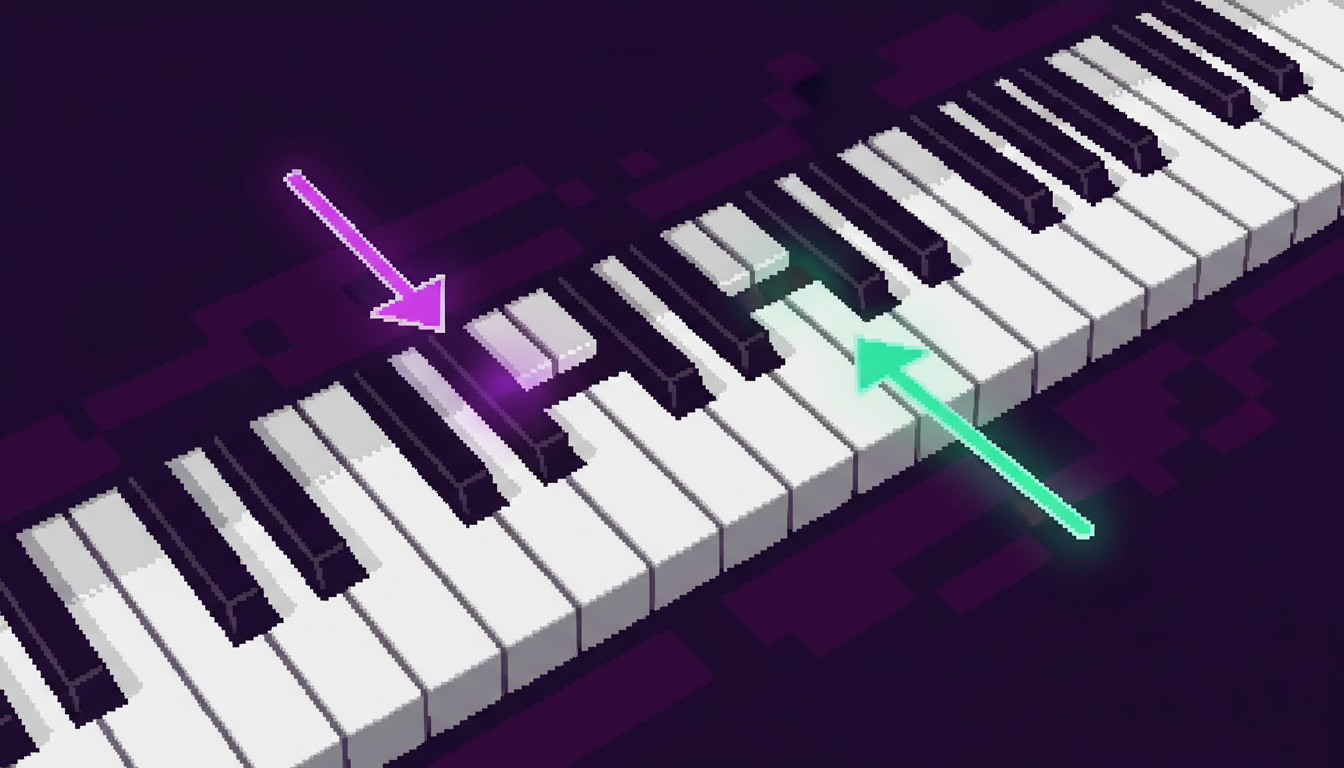
If music theory had a single atom, it would be the half step. Every interval, every scale, every chord, and every key signature is built from combinations of half steps and whole steps. Once you internalize those two distances, the rest of theory stops looking like memorization and starts looking like construction.
What is a half step in music?
A half step (semitone) is the smallest distance between two notes in Western music — the move from any piano key to the very next key, whether black or white. C to C#, E to F, B to C, and F# to G are all half steps. The natural half steps (white-to-white with no black key between) are E-F and B-C.
Some examples:
- C to C# is a half step
- E to F is a half step (no black key between them)
- B to C is a half step (also no black key between them)
- F# to G is a half step
The two pairs that catch beginners off guard are E-F and B-C. Most adjacent white keys have a black key between them, so they are a whole step apart. But E-F and B-C have no black key between them, which makes them half steps. That single fact is the source of every quirk in scale construction. Memorize it once, and you will never be confused again.
What is a whole step in music?
A whole step (tone) is two half steps stacked together — the move from one key to another with exactly one key skipped in between. C to D (skipping C#), F to G (skipping F#), and A to B (skipping A#) are whole steps. The skipped key can be black or white; what matters is that exactly one key is skipped.
Some examples:
- C to D is a whole step (skipping C#)
- F to G is a whole step (skipping F#)
- A to B is a whole step (skipping A#/Bb)
- E to F# is a whole step (skipping F)
- B to C# is a whole step (skipping C)
Notice that the skipped key can be black or white. What matters is that exactly one key is skipped, regardless of color.
Do the black keys matter for half steps and whole steps?
No. The black/white pattern is a visual aid, not a theoretical rule. A half step is one key over, regardless of color. The cleanest way to think: ignore the colors, count the keys. One key over is a half step. Two keys over is a whole step.
How do you build the major scale from steps?
The major scale follows the fixed pattern W-W-H-W-W-W-H in every key. Starting on C produces all white keys (C-D-E-F-G-A-B-C) because the natural half steps E-F and B-C land exactly where the formula needs them. Starting on G requires F# to honor the pattern — that’s why G major has one sharp.
W - W - H - W - W - W - H
Starting on C and applying the pattern:
| Step | From | Distance | To |
|---|---|---|---|
| 1 | C | W | D |
| 2 | D | W | E |
| 3 | E | H | F |
| 4 | F | W | G |
| 5 | G | W | A |
| 6 | A | W | B |
| 7 | B | H | C |
You arrive at C major: C - D - E - F - G - A - B - C. No accidentals required, because the natural half steps E-F and B-C land exactly where the formula calls for half steps.
Try the same formula starting on G:
G (W) A (W) B (H) C (W) D (W) E (W) F# (H) G
To make the pattern work, the seventh note has to be F#, not F. That is why G major has one sharp. The formula is rigid. The accidentals are whatever it takes to honor it.
How do you build the natural minor scale from steps?
The natural minor scale uses the pattern W-H-W-W-H-W-W. Starting on A produces A-B-C-D-E-F-G-A — same white keys as C major but starting on A. This is why A natural minor and C major are called relative keys: they share the same notes with a different tonal center.
W - H - W - W - H - W - W
Starting on A:
A (W) B (H) C (W) D (W) E (H) F (W) G (W) A
You arrive at A natural minor: A - B - C - D - E - F - G - A. Like C major, no accidentals are needed. A natural minor and C major share all seven notes, which is why they are called relative keys.
How do half steps determine interval names?
Every interval is named by the number of half steps between two notes. Minor 2nd = 1. Major 2nd = 2. Minor 3rd = 3. Major 3rd = 4. Perfect 4th = 5. Tritone = 6. Perfect 5th = 7. Minor 6th = 8. Major 6th = 9. Minor 7th = 10. Major 7th = 11. Octave = 12. The difference between major and minor is always one half step.
| Half Steps | Interval Name |
|---|---|
| 1 | Minor 2nd |
| 2 | Major 2nd |
| 3 | Minor 3rd |
| 4 | Major 3rd |
| 5 | Perfect 4th |
| 6 | Tritone (A4 / d5) |
| 7 | Perfect 5th |
| 8 | Minor 6th |
| 9 | Major 6th |
| 10 | Minor 7th |
| 11 | Major 7th |
| 12 | Perfect 8th (octave) |
Once you can count half steps reliably, you can identify or build any interval on demand. From C, four half steps up lands on E (a major third). From C, three half steps up lands on Eb (a minor third). The difference between major and minor at any quality of interval is exactly one half step.
How do you internalize half steps and whole steps?
Sing them — humming a half step (Jaws theme) and a whole step (Happy Birthday) builds the distance into your ear. Drill at the keyboard with random starting notes (after hundreds of reps you stop counting and start feeling). Spot the natural half steps (E-F, B-C) in every piece of music you read.
Sing them. Singing a half step (think the first two notes of Jaws) versus a whole step (the first two notes of Happy Birthday) builds the sound into your ear, not just your eyes.
Drill at the keyboard. Pick a random note and play a half step up, then a whole step up. Repeat starting from black keys, white keys, anywhere. After a few hundred reps, you will stop counting and start feeling the distance.
Spot the natural half steps in everything. Whenever you read a piece of music, glance for E-F and B-C transitions. Recognizing those moments is the fastest way to make sense of melodies and chord shapes.
Half steps and whole steps are the kind of skill that becomes invisible once you own it. Music Genius’s Theory Quest drills steps and the keyboard layout in Tier 1, with interactive exercises that let you build distances, identify them by ear, and apply them to scale construction. Pair with Major vs Minor Scales and Music Intervals Guide to extend the foundation.
Frequently Asked Questions
What is a half step in music?
A half step (also called a semitone) is the smallest distance between two notes in Western music. On a piano, it is the move from any key to the very next key, whether black or white. C to C#, E to F, B to C, and F# to G are all half steps. There is nothing in between.
What is a whole step in music?
A whole step (also called a tone) is two half steps stacked together. On the keyboard, it is the move from one key to another with exactly one key skipped in between. C to D, F to G, A to B, and E to F# are all whole steps. The skipped key can be black or white.
Where are the natural half steps on the piano?
There are only two natural half steps on the piano keyboard: E to F and B to C. These are the white-to-white moves that have no black key between them. Every other adjacent pair of white keys is a whole step apart. Knowing this is the foundation of scale construction.
What is the interval pattern of a major scale?
The major scale follows the pattern W-W-H-W-W-W-H (whole step, whole step, half step, whole step, whole step, whole step, half step). Starting on C produces all white keys (C-D-E-F-G-A-B-C). Starting on any other note requires accidentals to make the pattern work — that's why G major needs F# and Bb major needs Bb and Eb.
What is the interval pattern of a natural minor scale?
The natural minor scale follows the pattern W-H-W-W-H-W-W. Starting on A produces all white keys (A-B-C-D-E-F-G-A) — the same notes as C major but starting on A. This is why A minor is the relative minor of C major. The pattern shifts the half-step positions, lowering the 3rd, 6th, and 7th.
How many half steps are in each interval?
Minor 2nd = 1 half step. Major 2nd = 2. Minor 3rd = 3. Major 3rd = 4. Perfect 4th = 5. Tritone = 6. Perfect 5th = 7. Minor 6th = 8. Major 6th = 9. Minor 7th = 10. Major 7th = 11. Octave = 12. The difference between major and minor at any quality is exactly one half step.
Do black keys matter for half steps and whole steps?
No — the black/white pattern on the piano is a visual aid, not a theoretical rule. A half step is one key over, whether you're moving between two white keys (E-F), two black keys, or one of each. Count keys, not colors. The black keys exist because of where the natural half steps fall in the white-key layout.
PRACTICE WHAT YOU LEARNED
Put this knowledge to work with Music Genius — free music theory games that make practice fun.
Play Now — It's Free